


Executive Mentoring for Dynamics 365 and CRM Leaders

Leading a Dynamics 365 or Power Platform program often means making high-stakes decisions without a safe forum to test assumptions or challenge direction. Executive mentoring provides experienced, independent judgement to help leaders think clearly, anticipate consequences, and act with confidence when accountability sits squarely with them.
Judgement should feel supported. Not isolated.
If decisions still feel heavier than they should,
Book a Confidential Strategy Chat
Need focused clarity in a short window?
Discover the Executive Mentoring Sprint
Confidential support for leaders carrying complex accountability
Leadership roles that involve CRM, growth systems, or major change come with a particular kind of pressure.
- Decisions are visible.
- Consequences are real.
- Advice is plentiful, but rarely neutral.
Executive mentoring exists to give leaders a trusted, experience-based thinking partner when the responsibility sits squarely with them.
Executive mentoring provides a high-trust space to slow down thinking without slowing down delivery. It helps leaders separate signal from noise, make trade-offs explicitly, and stay anchored to outcomes when stakeholder pressure, partner advice, and internal politics pull in different directions. We work through the decisions that typically sit “between the lines”. How to hold boundaries on scope and governance without creating friction. How to interpret delivery narratives and status reporting with the right level of scepticism. How to reframe issues so they can be resolved rather than escalated. And how to communicate intent and expectations in a way that strengthens accountability and confidence across the program. The benefit is practical: fewer reactive decisions, clearer judgement under uncertainty, and leadership that feels in control even when complexity is rising.
What this service is for
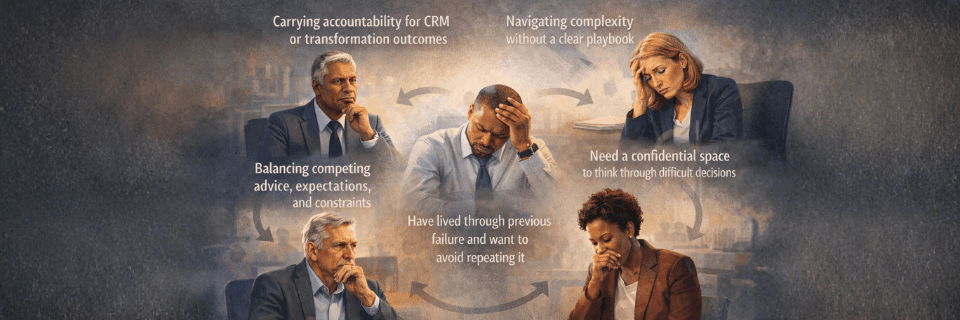
Executive mentoring supports leaders who:
- Carry accountability for CRM or transformation outcomes
- Are navigating complexity without a clear playbook
- Need a confidential space to think through difficult decisions
- Are balancing competing advice, expectations, and constraints
- Have lived through previous failure and want to avoid repeating it
This work is most valuable when the challenge is not technical, but human, political, or judgement-based.
What this mentoring looks like
This is not coaching in the generic sense.
It is practical, context-aware mentoring grounded in real delivery experience.
Typically, it involves:
- One-to-one, confidential conversations
- Discussion of live issues and upcoming decisions
- Exploration of trade-offs, risks, and second-order effects
- Sense-checking assumptions and options
- Pressure-testing thinking before decisions are made public
There are no templates and no scripts. Each engagement reflects the leader, their context, and what is at stake.
What makes this different
This mentoring is:
- Grounded in decades of real CRM and transformation work
- Independent of delivery incentives
- Focused on judgement, not performance management
- Designed to support leaders, not direct them
The value lies not in advice given, but in clarity gained.
When executive mentoring is most useful
Leaders typically engage mentoring:
- When stepping into accountability for CRM or major change
- After a difficult or high-profile program
- During periods of delivery stress or organisational tension
- When confidence has been dented, but responsibility remains
- When decisions must be made under uncertainty
In many cases, the most important outcome is avoiding the wrong decision, not accelerating the next one.
Executive Mentoring Sprint
For leaders who need clarity quickly rather than an open-ended engagement, the Executive Mentoring Sprint is a short, structured format designed to create space for deliberate thinking without committing to a long program.
It is typically used when pressure is rising, confidence in direction is slipping, or decisions are being made reactively. The sprint provides a defined window to step back, examine what is really happening, and decide what should happen next.
Time-boxed and outcome-focused, it helps leaders surface implicit decisions, separate platform issues from ownership and governance, and restore a deliberate decision rhythm.
For some, it becomes the starting point for ongoing mentoring. For others, it is a sufficient, contained reset that prevents prolonged uncertainty or misaligned action.
Discuss The Executive Mentoring Sprint
Typical outcomes
Leaders describe outcomes such as:
- Greater confidence in decision-making
- Reduced noise and conflicting advice
- Clearer articulation of risks and consequences
- Improved ability to hold boundaries and priorities
- A sense of being less alone in complex accountability
Often, the benefit is as much psychological as it is practical.
How this relates to other advisory work
Executive mentoring complements our other services:
- Roadmaps, by supporting leaders as priorities and sequencing are tested
- Decision Support, by providing a confidential space before formal decisions
- Enablement and Adoption, by reinforcing leadership behaviour and confidence
It can stand alone, or sit alongside other advisory engagements.
A final note on discretion
This work is intentionally quiet.
It is not programmatic.
It is not scaled.
It is not marketed aggressively.
It exists for leaders who value judgement, experience, and trust when the stakes are high.