


CRM Strategy, Delivery & Long-Term Success
Successful CRM environments rarely emerge from technology decisions alone.

They are shaped by strategy, governance, operational design, communication, leadership, and the quality of the decisions made throughout delivery.
At Opsis, we help organisations create a clearer view of how their CRM environment supports the business today, where complexity and operational friction may be increasing, and what is required to build systems that remain valuable over time.
Our work spans Microsoft Dynamics 365, the Power Platform, CRM strategy, governance, implementation, remediation, executive advisory, and long-term operational improvement.
This page explains some of the principles, delivery approaches, and practical realities that make our approach different.
Questions Answered On This Page
- How do organisations choose the right CRM or Dynamics 365 partner?
- Why do some CRM systems become difficult to manage over time?
- What should organisations expect beyond implementation?
- What are the risks of poorly governed delivery models?
- What helps CRM systems remain valuable long-term?

Why CRM Strategy Matters Beyond Implementation
Many CRM environments become harder to manage not because of a single major failure, but because of the accumulation of small decisions made under pressure over time.
Small Decisions Shape Long-Term Complexity
A new field is added to satisfy a reporting request. A workflow is introduced to solve an immediate operational issue. A process exception is created for one team. A piece of automation is rushed into production because the business needs results quickly. Each decision may appear reasonable in isolation. Collectively, however, those decisions shape how sustainable, understandable, and commercially valuable the CRM environment becomes.
This is one of the reasons CRM strategy matters far beyond the initial implementation itself.
CRM Systems Influence Operational Decision-Making
A CRM platform influences how organisations manage customer relationships, sales activity, reporting, service delivery, accountability, communication, and operational decision-making. When the underlying structure is unclear or poorly aligned to the business, the impact often extends well beyond the technology team:
-
- Reporting becomes harder to trust
- Changes become slower and more expensive to implement
- Different departments begin interpreting information differently
- Workarounds appear outside the system
- Teams become increasingly dependent on individual knowledge holders because the platform no longer feels intuitive or transparent.
In many organisations, these problems emerge gradually enough that they are accepted as normal operational friction rather than recognised as indicators of a deeper structural issue.
At Opsis, we approach CRM environments as operational systems rather than isolated software projects. That distinction influences how we think about strategy, delivery, governance, and long-term success.
Technology Alone Does Not Create CRM Success
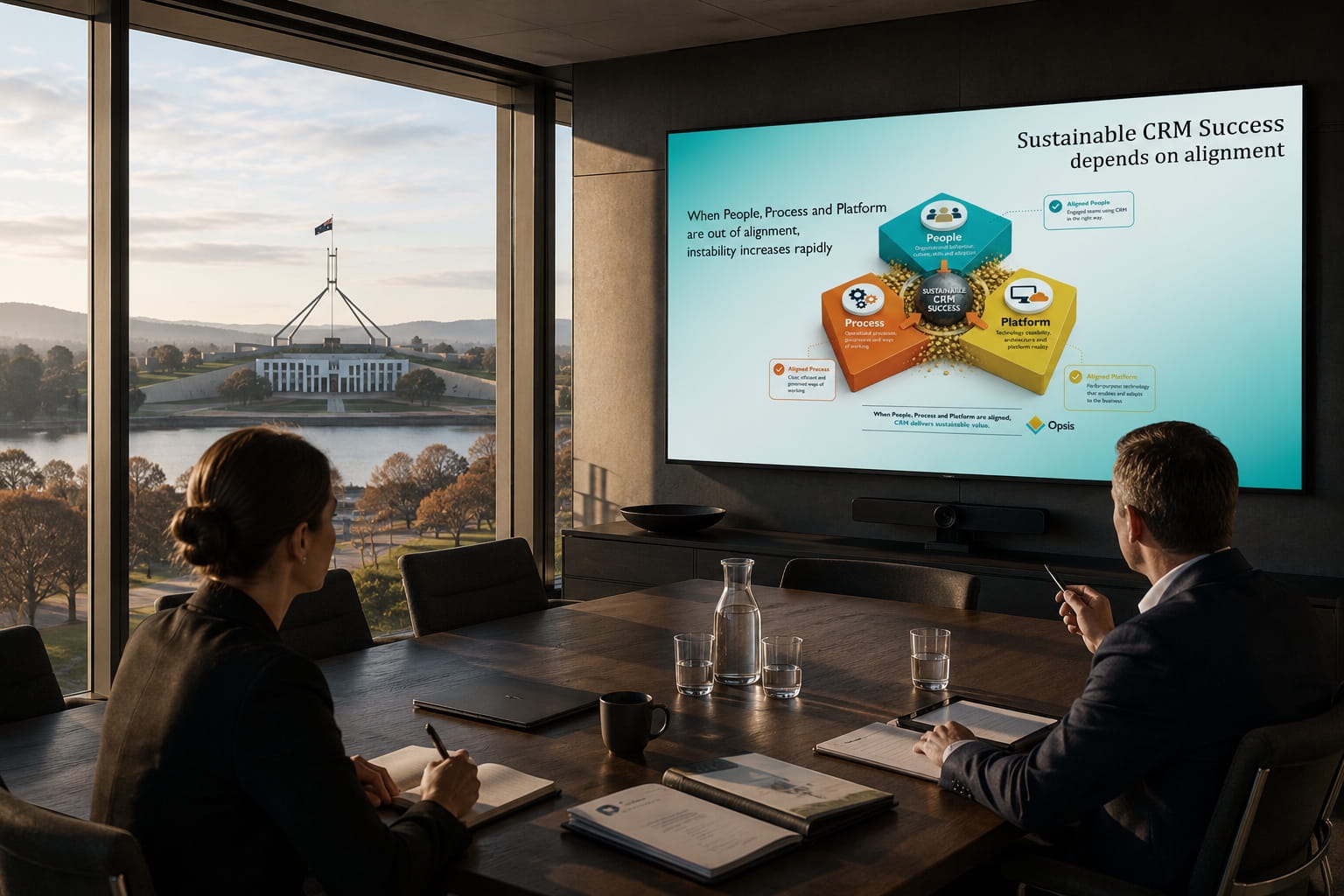
Technical capability matters, but successful CRM environments also depend on communication quality, business alignment, governance maturity, reporting clarity, stakeholder decision-making, and the organisation’s ability to maintain confidence in the platform as it evolves.
This is particularly important in Microsoft Dynamics 365 and Power Platform environments, where the flexibility of the platform creates enormous opportunity, but also increases the importance of design discipline and governance. Without clear architectural thinking, even highly capable platforms can become difficult to manage over time. Our approach therefore focuses not only on what can be built, but also on what should be built, why it matters operationally, and how the organisation will sustain the environment long after implementation activity slows down.
Designing CRM Systems For Long-Term Sustainability
In practice, this often means helping organisations:
- clarify operational requirements before configuration begins
- identify where governance responsibilities sit
- simplify unnecessarily complex processes
- improve reporting integrity and data visibility
- reduce dependency on fragile workarounds
- align technical delivery with business priorities
- support executive decision-making during delivery
- stabilise environments that have become difficult to manage
It also means recognising that CRM success is not created by technology teams alone.
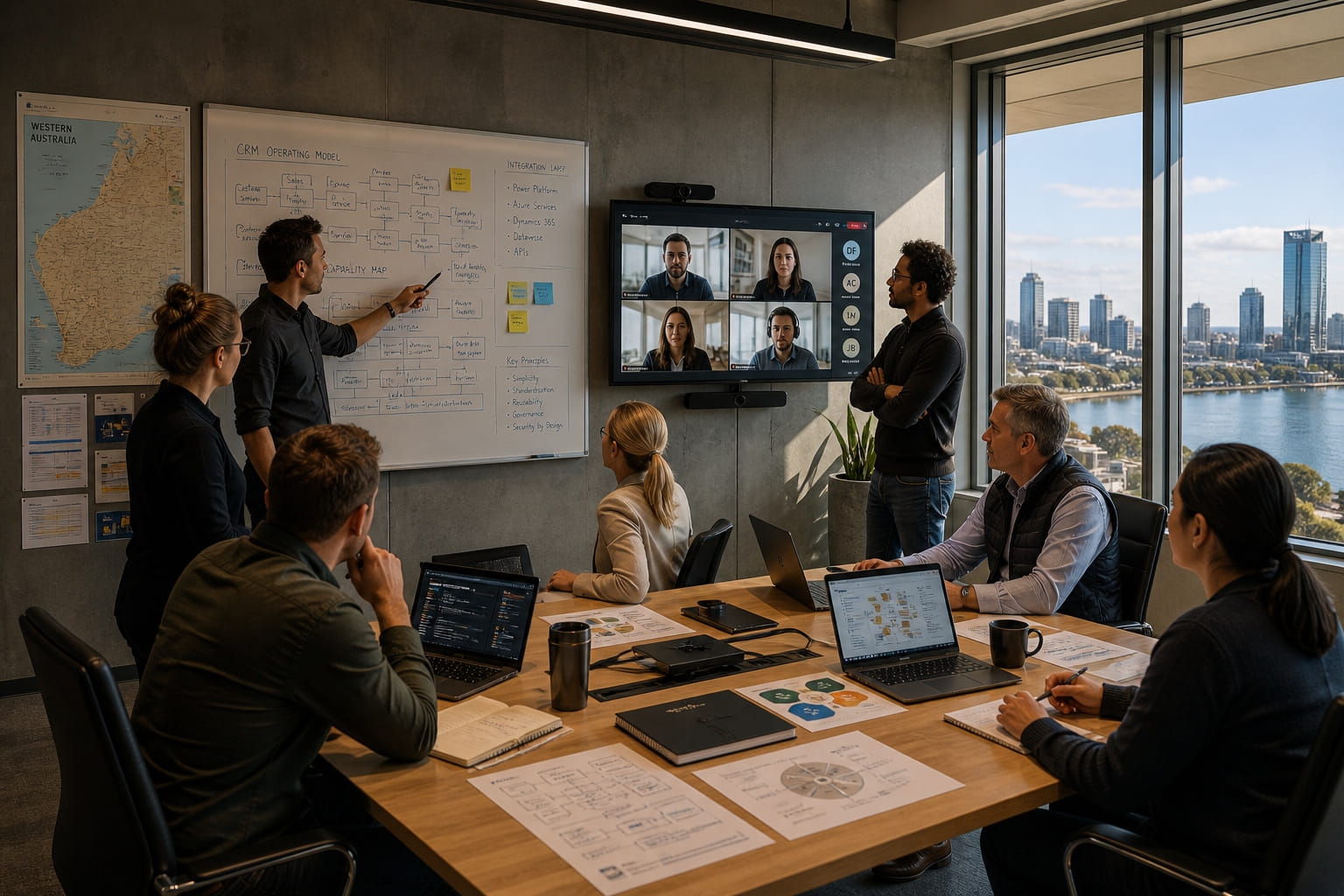
The most effective CRM environments usually emerge when leadership, operational stakeholders, technical teams, and delivery partners share a sufficiently clear understanding of:
- how the organisation works
- what the platform is intended to support
- where accountability sits
- how decisions are made
- and what long-term success should actually look like
This is one of the reasons we place significant emphasis on creating a clear view of the organisation’s operational reality before making large technical decisions.
Sometimes that results in implementation work. Sometimes it results in governance changes, executive advisory, process redesign, remediation planning, or simplification. In many cases, the most valuable decision is not adding more functionality, but reducing unnecessary complexity before it becomes embedded more deeply into the organisation.
Long-term CRM success is rarely about achieving a perfect go-live moment.
It is about creating systems that remain useful, governable, understandable, and commercially valuable as the organisation evolves.
Choosing the Right CRM & Dynamics 365 Partner
Selecting a CRM or Microsoft Dynamics 365 partner is rarely just a technology decision. It is also a decision about communication, governance, operational understanding, accountability, and the quality of the thinking that will shape the environment over time.
Many organisations initially evaluate CRM partners based on platform certifications, implementation pricing, delivery capacity, or familiarity with Microsoft technology. Those things are important, but they do not always determine whether the resulting CRM environment becomes commercially valuable, operationally sustainable, or increasingly difficult to manage.
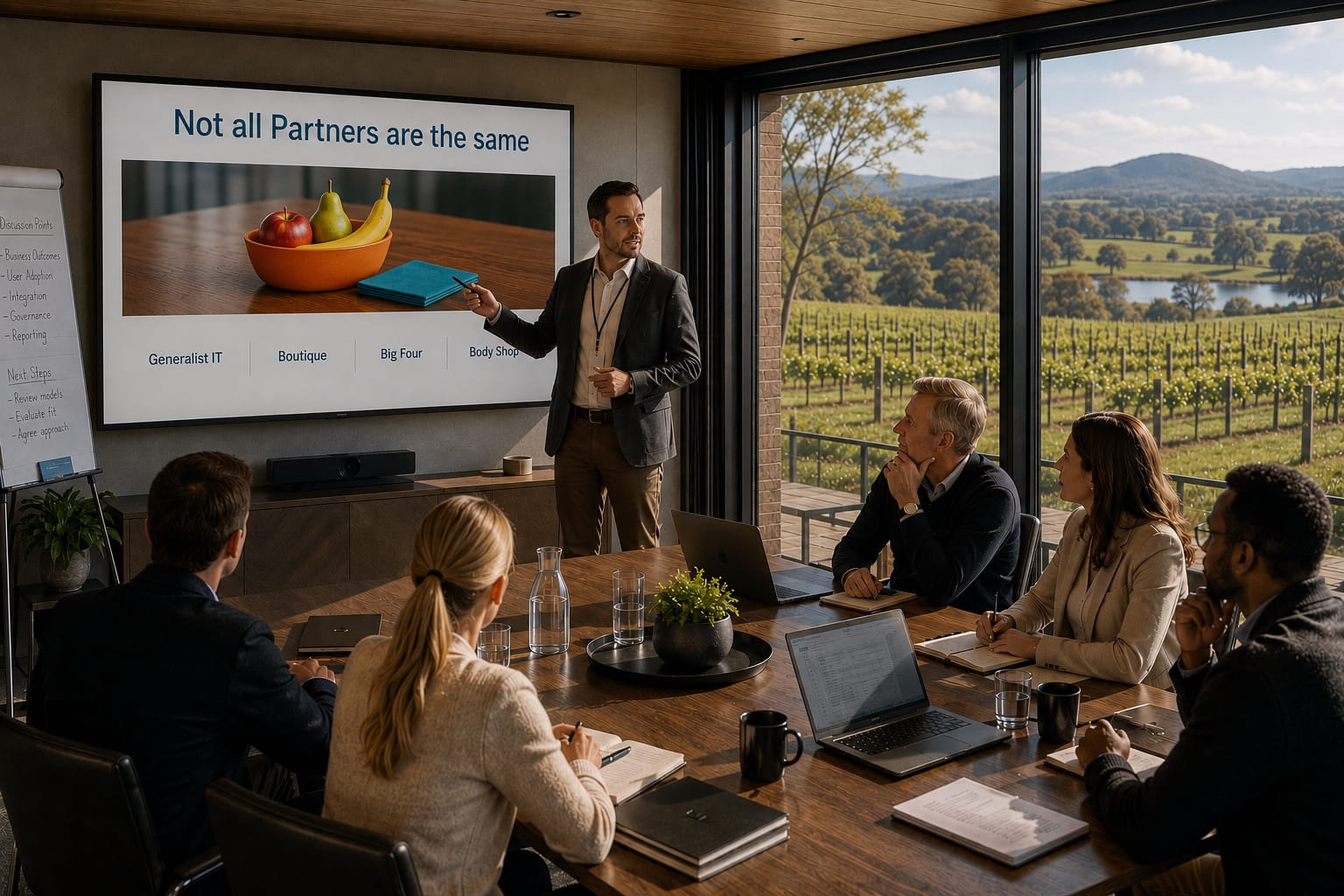
CRM platforms sit at the intersection of people, process, platform, ie the convergence of reporting, operations, customer experience, and organisational decision-making. The quality of the implementation therefore depends not only on technical capability, but also on whether the delivery team understands how the organisation actually operates.
That distinction becomes increasingly important as environments grow in complexity.
CRM Delivery Models Are Not All The Same
Not all CRM partners deliver services in the same way, even when their proposals appear similar on paper.
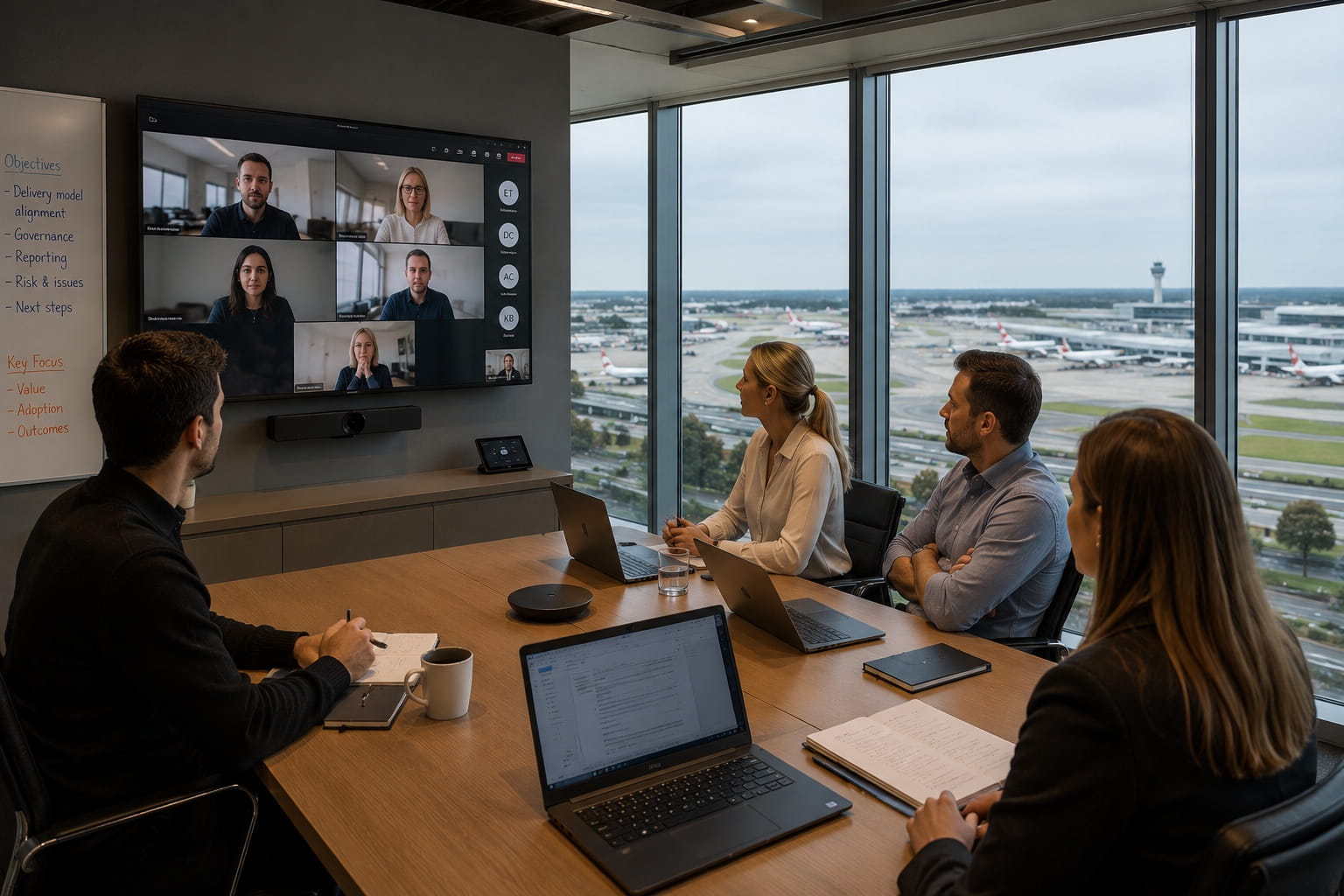
Some organisations primarily provide strategic advisory capability. Others focus on technical implementation. Some operate as large delivery factories with layered project structures and rotating resources. Others provide highly specialised senior expertise supported by smaller teams. Some organisations rely heavily on offshore delivery capacity, while others maintain tightly integrated local delivery models.
None of these approaches are automatically wrong. However, they create very different delivery experiences.
In many CRM projects, organisations discover too late that they were not actually buying direct access to senior expertise. Instead, they purchased access to delivery capacity, project administration, or heavily segmented implementation teams where strategy, architecture, configuration, training, and support were disconnected from one another.
When responsibility becomes fragmented, important operational decisions can also become fragmented.
At Opsis, we believe organisations should have clarity about:
- who is actually doing the work
- where senior expertise sits
- how decisions are made
- how governance is maintained
- and who remains accountable when difficult trade-offs arise
This is one of the reasons we intentionally operate as a senior-led consultancy. We are large enough to support organisations properly and small enough to remain directly engaged in the quality of outcomes.
Communication And Operational Understanding are often Misaligned
CRM environments depend heavily on shared understanding.
A technically correct solution can still create operational problems if the original business requirement was misunderstood, oversimplified, or interpreted differently by different stakeholders.

This is particularly important in projects involving:
- multiple vendors
- distributed delivery teams
- significant time zone separation
- layered subcontracting arrangements
- highly technical specialists with limited operational exposure
Even when everyone involved technically speaks the same language, organisations often discover that operational terminology, governance expectations, reporting assumptions, and communication styles are interpreted differently across teams.
Time zone differences can also affect more than meeting scheduling. They can influence issue resolution speed, workshop effectiveness, stakeholder engagement, delivery momentum, and the organisation’s ability to make timely decisions during implementation.
Successful CRM delivery therefore requires more than technical coordination alone. It requires enough operational understanding and communication clarity that business intent can be translated accurately into sustainable system design.
Technical Capability Alone Is Not Enough
Strong CRM environments are rarely created through configuration alone. They depend on architecture, governance, reporting integrity, leadership alignment, operational clarity, and disciplined decision-making throughout delivery.

Without those things, even highly capable platforms such as Microsoft Dynamics 365 and the Power Platform can gradually become more difficult to evolve, support, and trust operationally.
At Opsis, much of our work involves helping organisations simplify complexity before it becomes embedded more deeply into the business. Sometimes that means implementation support. Sometimes it means governance design, executive advisory, remediation planning, stakeholder alignment, or helping organisations regain visibility into how their CRM environment is actually functioning.
In many situations, the most valuable contribution is not adding more functionality, but helping organisations make clearer and more sustainable decisions.
What Organisations Should Look For In A CRM Partner
While every organisation is different, successful CRM partnerships often share several characteristics:
- direct access to experienced decision-makers
- strong communication between business and technical teams
- governance discipline without unnecessary bureaucracy
- practical operational understanding
- transparency around delivery structures and responsibilities
- architectural thinking before heavy configuration
- willingness to challenge poor assumptions early
- focus on long-term sustainability rather than short-term delivery activity
- enough scale to support the organisation properly, without becoming disconnected from day-to-day realities

Most importantly, organisations benefit from partners who remain focused on business outcomes rather than simply platform activity.
Successful CRM environments are rarely defined by how quickly the system was deployed. They are defined by whether the organisation still trusts, understands, and benefits from the platform years later.
Beyond CRM Implementation
Successful CRM environments are not sustained by implementation activity alone. They are sustained by operational understanding, governance continuity, ongoing support, and the organisation’s ability to maintain capability as teams, processes, and business conditions evolve over time. This is one of the reasons CRM success often becomes more difficult after go-live rather than easier.
Many organisations invest heavily in platform selection, implementation delivery, configuration, integrations, and reporting. However, far less attention is often given to what happens after the original project team disperses, experienced staff move on, business processes evolve, or operational knowledge begins to fragment across the organisation.
In practice, CRM environments must survive:
- staff turnover
- restructures
- changing leadership priorities
- evolving governance models
- hybrid work environments
- multiple generations of users
- changing user interfaces and platform updates
- operational shortcuts that gradually become embedded into day-to-day behaviour

When organisations do not actively maintain operational capability, small misunderstandings can gradually accumulate into larger operational problems. This is particularly visible in training. Many organisations still rely heavily on:
- one-off onboarding sessions
- static user manuals
- online learning modules
- “sit with Nellie” knowledge transfer
- or compliance-style tick-box training
Those approaches are not automatically wrong. However, they often assume that organisational understanding will remain stable over time.
In reality, that is rarely how modern organisations operate. Recently, I saw an example involving refresher training for a customer-facing team working within a CRM environment. Staff were instructed that if a customer call used an interpreter service, they needed to “make a note” of it within the system.
The operational reason behind the instruction became obvious once explained. Calls involving interpreters carried additional risk of misunderstanding and needed to be identifiable later if questions, complaints, or governance issues arose. However, the training itself focused on the instruction rather than the operational purpose behind it. At the same time, the CRM user interface had changed since some of the original online training materials were created, making parts of the process appear inconsistent with the live system the team was actually using. As a result, the training created uncertainty rather than clarity.
The issue was not intelligence, effort, or willingness to learn. The issue was that the operational context behind the process had not been communicated clearly enough for the instruction to remain meaningful once the surrounding organisational knowledge became fragmented.

CRM environments experience this constantly.
Users are often trained on:
- fields
- workflows
- forms
- mandatory steps
- reporting processes
- governance rules
without fully understanding:
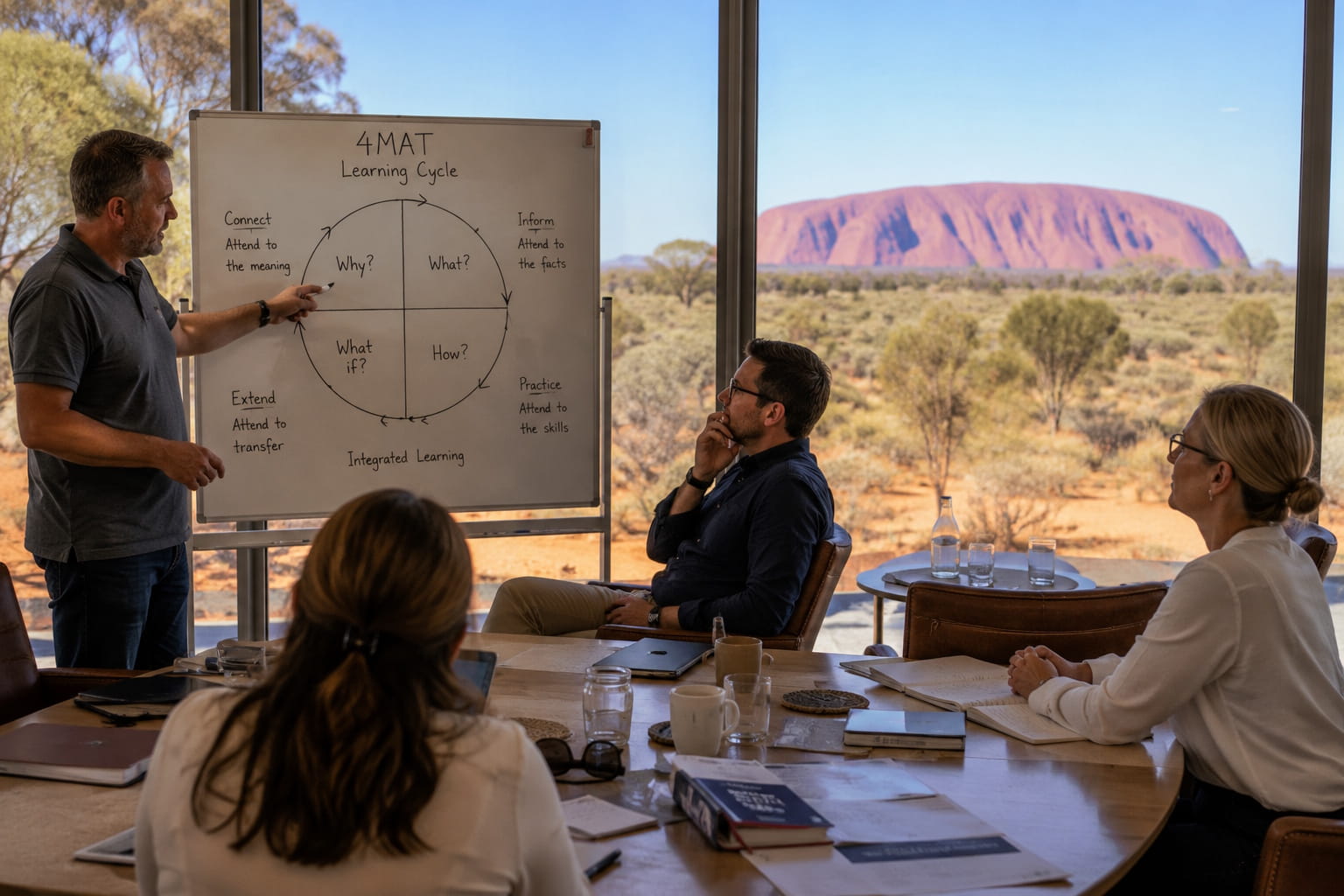
- why those things exist
- what operational risk they are managing
- how the information will later be used
- or what happens when the process is followed inconsistently
Over time, this creates environments where teams know the steps, but not always the operational intent behind them.
That distinction matters.
At Opsis, we believe sustainable CRM capability depends on more than technical familiarity with the platform itself. It requires organisations to continuously reinforce operational understanding, governance expectations, reporting integrity, and the business purpose behind the processes users are expected to follow.
This is one of the reasons we place significant emphasis on:
- ongoing end-user support
- operational coaching
- governance reinforcement
- executive visibility
- process clarity
- adoption maturity .... and
- maintaining organisational understanding as teams evolve
Because successful CRM environments are not simply implemented once and left untouched. They require ongoing stewardship to remain understandable, governable, and commercially valuable as the organisation changes around them.
What Are You Actually Buying?
CRM delivery models are not interchangeable, even when the proposals, certifications, or platform logos appear similar on paper.

Different providers optimise for different things: governance, scale, implementation throughput, strategic advisory, operational support, technical depth, or staffing capacity. Understanding those differences matters because organisations are rarely just purchasing software configuration. They are purchasing combinations of architecture, communication, governance, operational understanding, delivery capability, and long-term accountability.
Large Consulting Firms And Transformation Programmes
Large consulting firms are often well suited to complex enterprise transformation programmes involving multiple business units, procurement structures, governance layers, and executive stakeholder groups. They typically bring strong programme governance, formal delivery structures, and broad organisational scale.
However, those models often rely heavily on layered teams and leverage structures where senior people shape the engagement, but more junior resources perform much of the day-to-day delivery. This can work well when supervision, architecture, and continuity remain strong, but organisations should understand how delivery responsibility is actually distributed.
Body Shop And Delivery Factory Models
Some delivery models primarily optimise for staffing capacity and implementation throughput. In these environments, organisations are often purchasing access to resources rather than direct operational ownership or strategic guidance.

That does not automatically make the model wrong. Many organisations need implementation scale. However, it does increase the importance of governance, architectural oversight, and supervision quality. A CRM resource supplied into a project is not automatically responsible for the wider operational outcome. In some cases, organisations receive a capable individual contributor, but little surrounding structure, continuity, or strategic accountability.
Generalist IT Providers And MSPs
Generalist IT providers and managed service providers are often highly effective at infrastructure, security, licensing, cloud operations, and Microsoft ecosystem support. However, CRM environments sit deeply inside operational processes, reporting, customer interactions, and organisational behaviour.
The skills required to manage infrastructure are not always the same as the skills required to design sustainable CRM operating models, governance structures, adoption approaches, or reporting frameworks.
Boutique CRM Specialists
Boutique CRM consultancies often operate with smaller senior-led teams and closer operational involvement. This can create stronger continuity, more direct access to experienced consultants, and better alignment between strategy, architecture, delivery, training, and support.

The trade-off is usually scale. Smaller firms may not provide the same resource depth as large transformation programmes. However, organisations often benefit from more direct accountability and stronger continuity of understanding across the lifecycle of the CRM environment.
Offshore And Distributed Delivery Models
Offshore and distributed delivery models can work extremely well when supported by strong operational leadership, disciplined governance, experienced architectural oversight, and clear communication pathways.
Without those things, organisations can find themselves managing coordination complexity instead of business improvement. Time zone separation, communication delays, layered subcontracting, and operational misunderstandings all introduce additional overhead that must be actively managed by someone. Successful distributed delivery rarely happens accidentally.
The Roles Inside a CRM Project Matter
Not all CRM roles are interchangeable. A Solution Architect, Functional Consultant, Technical Consultant, Business Analyst, Trainer, Support Lead, and Project Manager all contribute different forms of expertise.
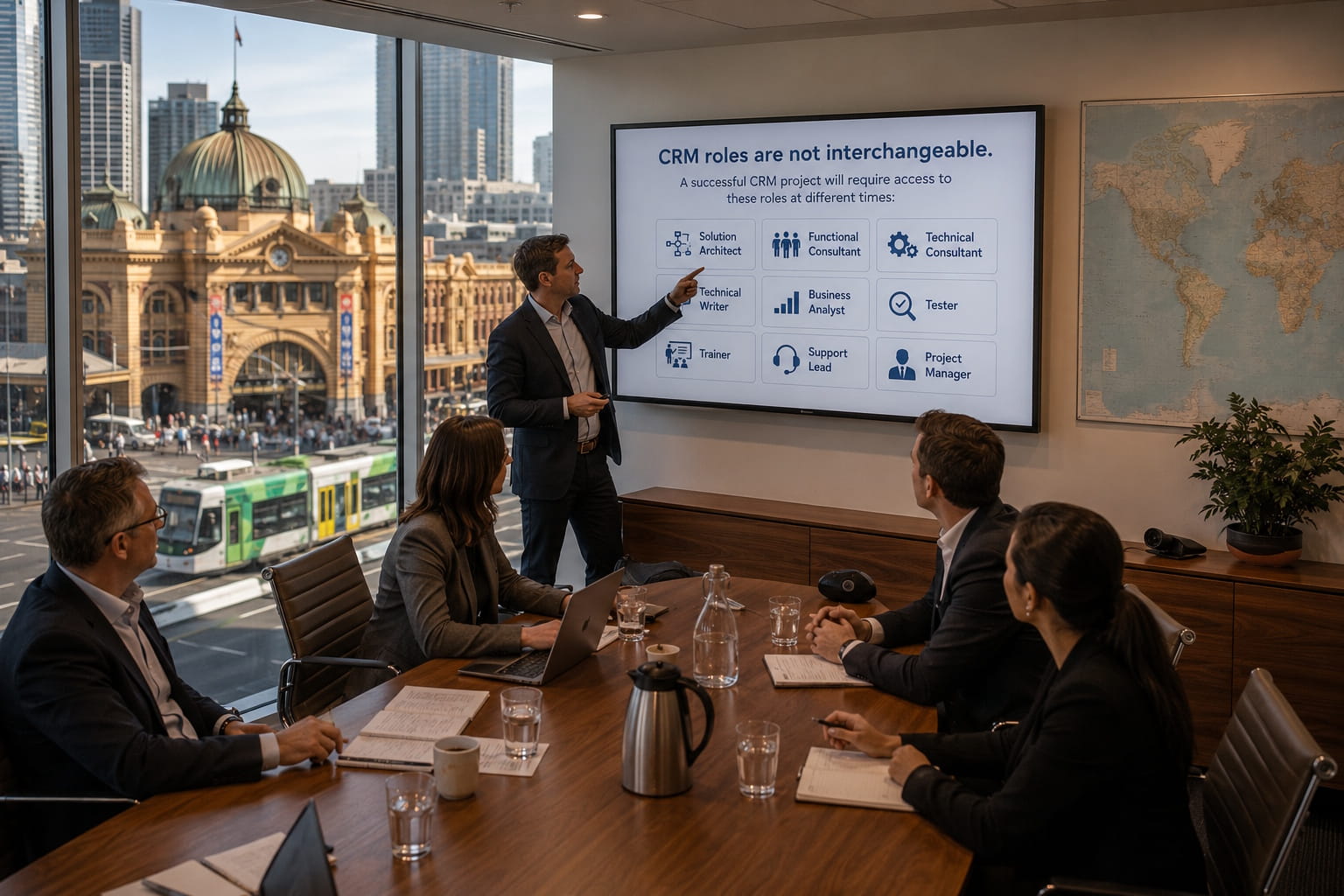
In some projects, these responsibilities are distributed across highly specialised teams. In others, the same individual may simultaneously act as analyst, configurator, trainer, support contact, and architect. Neither approach is automatically right or wrong, but organisations should understand who is responsible for what, where seniority sits, and how operational decisions are being governed.
Questions Organisations Should Ask Before Signing
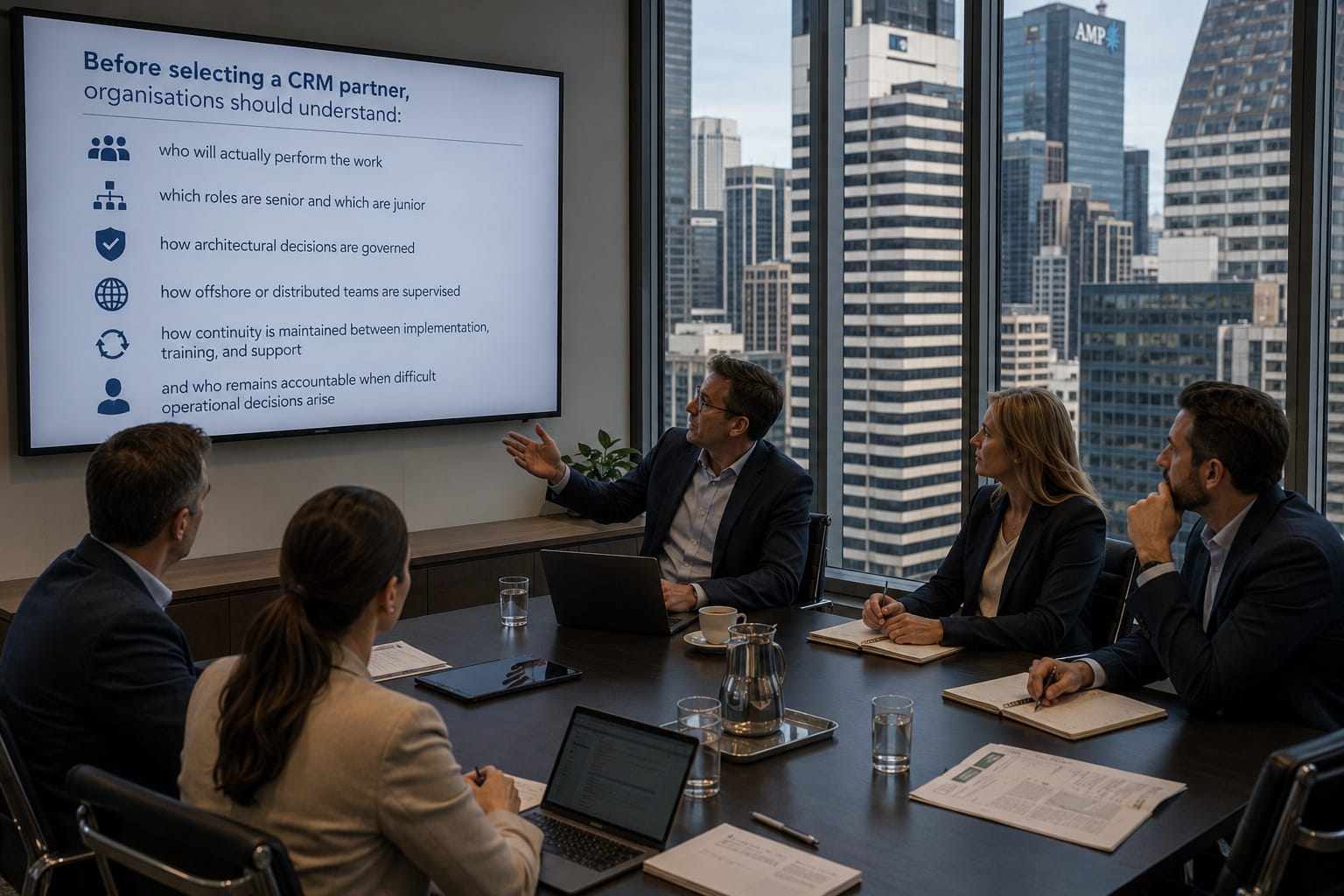
Before selecting a CRM partner, organisations should understand:
- who will actually perform the work
- which roles are senior and which are junior
- how architectural decisions are governed
- how offshore or distributed teams are supervised
- how continuity is maintained between implementation, training, and support
- and who remains accountable when difficult operational decisions arise
Formal RFx and procurement processes can be valuable for governance and commercial comparison. However, they do not always make delivery models, supervision structures, architectural ownership, or operational assumptions fully visible.
Some proposals are optimised primarily to score well during procurement evaluation rather than to create long-term operational simplicity or continuity after implementation begins.
The most expensive CRM delivery model is not always the one with the highest rates. It is often the one that creates the most long-term operational confusion, rework, dependency, or governance erosion.
Why Some CRM Environments Become Difficult To Manage
Most CRM environments do not become difficult to manage because of a single catastrophic decision.
The problems usually emerge gradually through a combination of operational pressure, fragmented decision-making, governance erosion, staff turnover, inconsistent communication, and design compromises that accumulate over time.
At first, many of these decisions appear reasonable.
Small Decisions Accumulate Over Time
A new field is added to satisfy a reporting request. A workflow exception is introduced for a specific team. An automation is rushed into production because the business needs immediate results. A process is duplicated because different departments interpret requirements differently. A workaround becomes permanent because no-one has time to redesign the underlying issue properly. Individually, none of these decisions may appear significant. Collectively, they can fundamentally change how the CRM environment behaves.
Over time:
- reporting becomes harder to trust
- changes become slower and more expensive
- governance weakens
- operational ownership becomes unclear
- teams create workarounds outside the platform
- dependency on individual knowledge holders increases
- and the system gradually becomes more difficult to evolve safely
This is one of the reasons we often describe CRM complexity as a form of operational gravity.
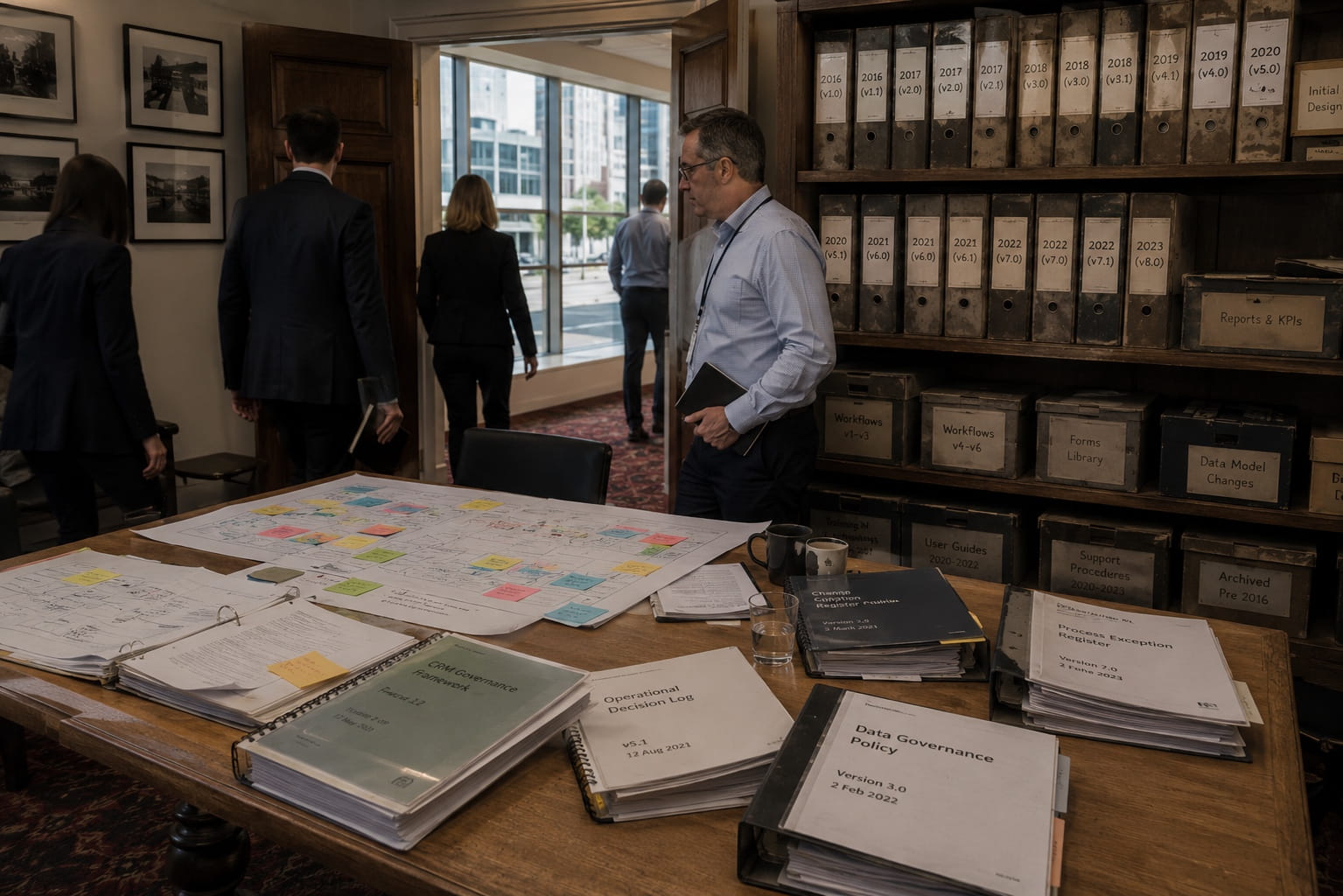
Complexity, governance friction, technical debt, process debt, and communication breakdowns gradually pull CRM environments away from sustainable operational value and toward increasing cost, confusion, and organisational dependency.
CRM Complexity Is Rarely Just Technical
This process is rarely purely technical.
In many organisations, different parts of the project team are effectively operating with different assumptions about:
- business priorities
- governance expectations
- operational terminology
- reporting definitions
- architectural ownership ... or
- what“success” actually means
When communication between business stakeholders, technical teams, vendors, and operational leadership weakens, those inconsistencies become embedded into the platform itself.
This is particularly visible in environments where:
- project phases are heavily segmented
- responsibilities rotate between teams
- offshore delivery operates with limited operational context
- governance ownership is unclear
- or implementation activity moves faster than organisational understanding
Agile Delivery Still Requires Architectural Discipline
Agile delivery approaches can amplify this risk if the overall architecture, governance model, and operational direction are not sufficiently clear from the beginning. Agile itself is not the problem.
In fact, iterative delivery can be extremely effective when supported by strong architectural thinking and disciplined governance. However, when organisations interpret Agile as “we no longer need to design properly up front,” environments often become increasingly fragmented as individual requests accumulate release by release without enough attention being given to long-term coherence.
CRM environments must survive organisational change.
Experienced users leave. Leadership priorities shift. New teams inherit processes they did not design. Workarounds spread informally. Reporting assumptions become disconnected from operational reality. Training materials become outdated as interfaces and processes evolve.
Complexity Must Be Actively Managed
Over time, organisations can find themselves operating systems that technically still function, but no longer feel fully understandable or governable.
At Opsis, much of our work involves helping organisations identify these patterns before they become deeply embedded into day-to-day operations.
This often involves:
- simplifying unnecessarily complex processes
- clarifying governance ownership
- improving operational visibility
- restoring reporting trust
- reducing dependency on fragile workarounds
- strengthening communication pathways
- and helping teams re-establish a shared understanding of how the CRM environment is intended to support the business
Successful CRM environments are not created through technology alone. They depend on alignment between people, process, platform, governance, communication, and operational decision-making over time.
When that alignment weakens, complexity rarely remains static. It accumulates.